Elsa von Freytag-Loringhoven
The woman who lived Dada
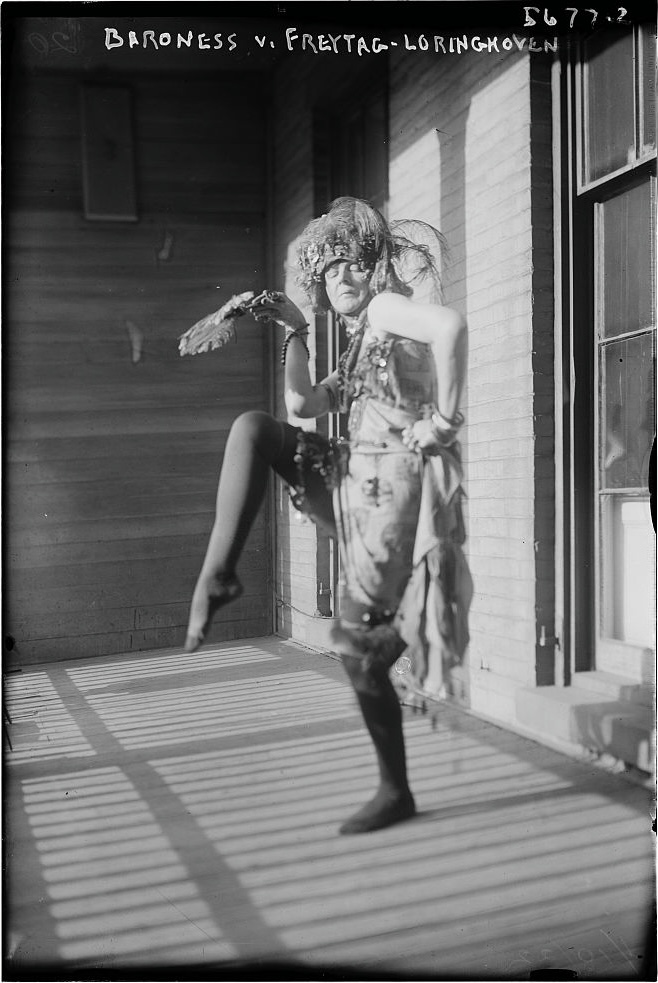
The woman who lived Dada
For decades, Elsa von Freytag-Loringhoven occupied a strange place in art history: she was there, right at the birth of the New York avant-garde, she wrote, created objects, turned her own appearance into an artistic form and was considered a pioneer of American Dada. Yet her name became far more blurred than those of other artists in her circle. Today it returns again and again for one especially uncomfortable reason: some researchers believe she may have been connected to Fountain, the famous 1917 urinal attributed to Marcel Duchamp.*
But reducing her to that controversy would be to lose her all over again.
Elsa was born in 1874 in Pomerania, then part of the German Empire. Her youth was marked by a difficult family life*, she studied art in Dachau and moved through several European and American cities before settling in Greenwich Village, New York, in 1913. There she was an artist, poet, model and a presence that was difficult to separate from her own work. MoMA describes her as a pioneer of American Dada and also notes how much of her personal and collaborative production was overshadowed by that of her contemporaries.
An artist who did not end where the artwork ended
Elsa made works from found objects and worked with readymades, but poetry was also a fundamental part of her production. She published texts in The Little Review and used fragmented, absurd and experimental language, combining and breaking words apart to build new ones.
But probably the most radical thing about her was that there seemed to be no very clear boundary between the artist and the person.
Her appearance extended her practice. She used objects, found materials and unconventional accessories, and became known in New York for a look many contemporaries considered excessive or eccentric. According to documentation held by MoMA, she herself understood that appearance as part of her work.
In other words: Elsa did not need to enter a museum before she could start making art.
That fitted Dada perfectly.
The movement had emerged during the First World War as a break with many of the rules that had previously seemed to define art. There was no single Dada style: it could take the form of absurd poetry, collage, performance, assemblage, provocation or the use of everyday objects. What mattered was questioning the conventions that determined what should count as art and how an artist should behave.
Elsa seemed to live precisely in that territory.
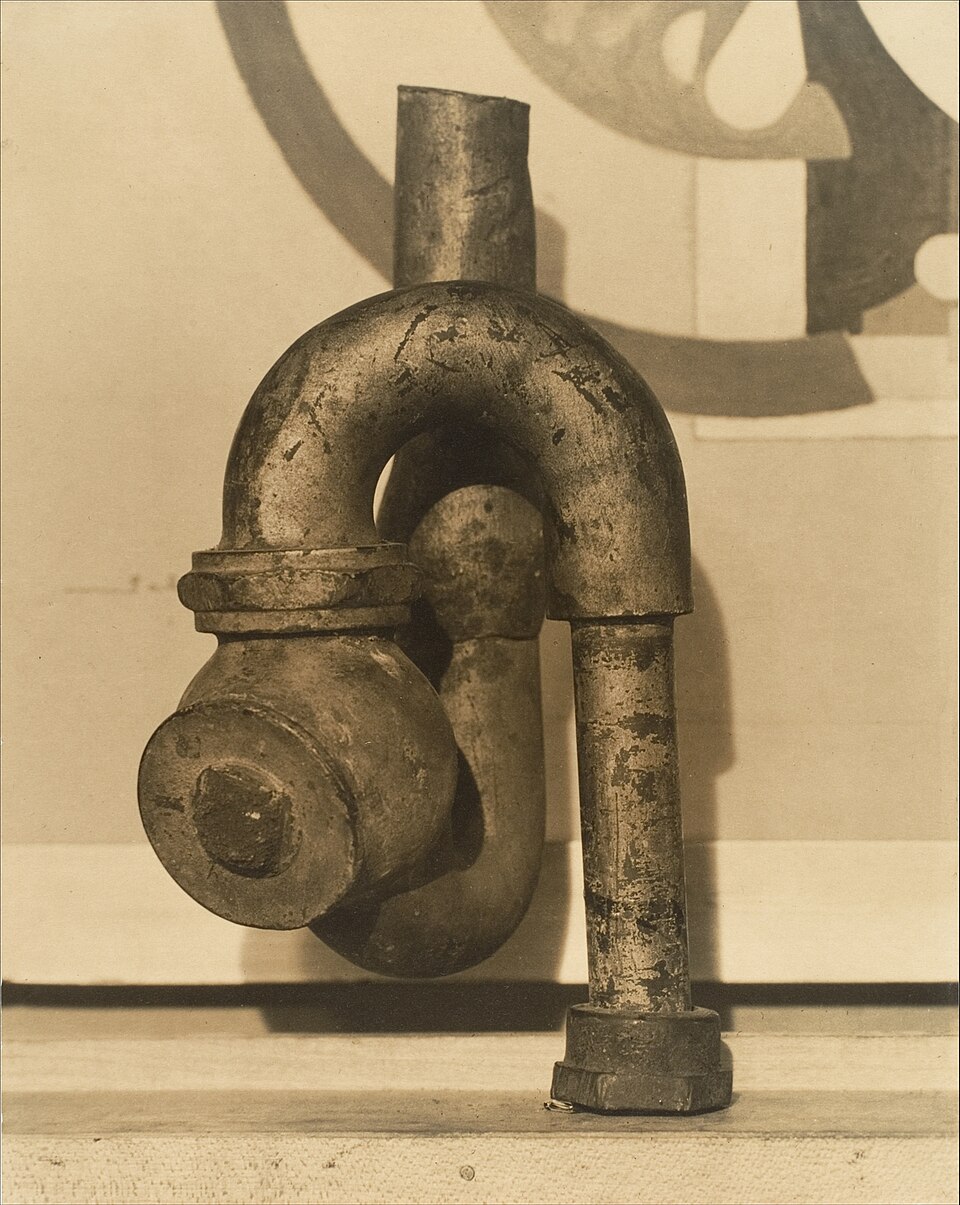
Elsa von Freytag-Loringhoven and Morton Schamberg, God, 1917. Gelatin silver photograph. The Metropolitan Museum of Art, The Elisha Whittelsey Collection, The Elisha Whittelsey Fund, 1973. CC0 / public-domain image.
MoMA holds, for example, her Dada Portrait of Berenice Abbott, made approximately between 1923 and 1926. The work combines gouache, metallic paint, varnish, paper, glass beads, metal objects, fabric and other materials. It does not function like a traditional portrait: it is drawing, object and accumulation at the same time.
And yet for a long time it was easier to remember Elsa as “the Baroness”, an eccentric of Greenwich Village, than to give her the same weight as other names of the avant-garde.
1917: a urinal appears at an exhibition
In the spring of 1917, the Society of Independent Artists was preparing its first major exhibition in New York.
The organisation had decided that there would be no jury selecting the works: artists who met the conditions for participation could submit their work.
Then a porcelain urinal appeared.
It had been positioned differently from the way it had been designed to be used, bore the signature “R. Mutt 1917” and was given the title Fountain.
The organisation decided not to show it.
Marcel Duchamp, who had been involved in founding the Society of Independent Artists, resigned after the rejection. Shortly afterwards he took the object to photographer Alfred Stieglitz, who made the image that would become the main visual record of the original Fountain.
The 1917 urinal disappeared soon afterwards. We do not know for certain whether it was destroyed or simply lost.
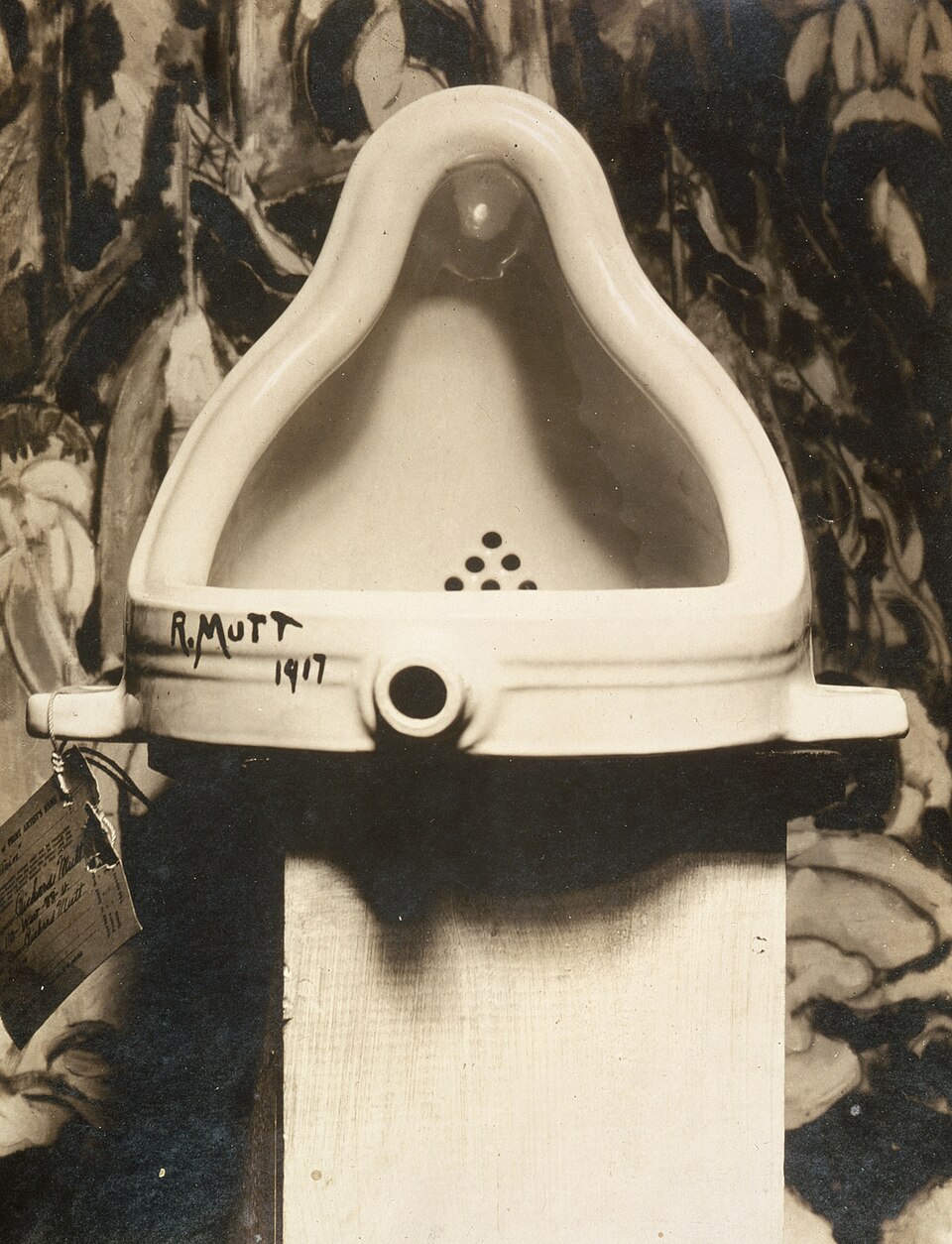
Fountain, 1917, attributed to Marcel Duchamp. Photograph of the original object by Alfred Stieglitz. Published in The Blind Man, 1917. Public-domain image.
What we see in museums today is not that object.
Decades later, Duchamp authorised several reproductions. The Philadelphia Museum of Art holds a version made in 1950, the earliest of the fourteen known full-size replicas. The museum also notes that Duchamp had previously begun reproducing Fountain in miniature inside his Box in a Valise (Boîte-en-valise).
The disappearance of the original is almost perfect for a work that would become the symbol of a much larger question: does an artist need to physically make an object for that object to become art?
In 2004, that influence received an almost symbolic confirmation. A survey of 500 art-world professionals — including artists, critics, curators and dealers — ranked Fountain as the most influential work of modern art, ahead of Picasso’s Les Demoiselles d’Avignon and Andy Warhol’s Marilyn Diptych.
But there is a problem.
More than a century later, we are still arguing about who actually made the gesture that turned that urinal into Fountain.
The letter that complicates the story
On 11 April 1917, Marcel Duchamp wrote from New York to his sister, the artist Suzanne Duchamp.
The correspondence exists and is documented in archives connected to Duchamp.
In it, Duchamp explains that a female friend of his had submitted a porcelain urinal as a sculpture using the male pseudonym Richard Mutt.
That document is one of the main reasons the traditional story of Fountain has been questioned.*
Duchamp does not write the name of that friend.
He does not say it was Elsa.
Nor does he explain who physically wrote “R. Mutt”, who chose the urinal or who first had the idea of submitting it as an artwork.
All we know is that, in a letter written only days after the events, Duchamp referred to a female friend who had sent it in.
Decades later, researchers such as Irene Gammel proposed that this woman may have been Elsa von Freytag-Loringhoven.* Other authors subsequently developed that hypothesis and have even argued that Elsa should be considered the author or co-author of Fountain.*
The proposal rests on several clues, although none of them constitutes proof on its own.
Elsa belonged to the New York avant-garde milieu and worked with found objects and readymades. Some supporters of the hypothesis also point to her connections with Philadelphia during that period and have linked this circumstance to the possible origin of the urinal or its submission.*
A possible linguistic game in the signature “R. Mutt” has also been suggested. Armut means “poverty” in German, Elsa’s native language, and some researchers have proposed that the resemblance may have been deliberate.* The traditional explanation of the name, on the other hand, has connected it with J. L. Mott Iron Works, while links to the popular comic strip Mutt and Jeff have also been proposed.*
None of these interpretations settles the matter.
They do not prove that Elsa bought, signed, submitted or conceived Fountain.
Other historians and Duchamp specialists have rejected the attribution to Elsa or argued that the known evidence does not allow her to be identified as the “female friend” in the letter.*
And that remains the essential point:
we do not know who that woman was.
So is Fountain Duchamp’s?
The temptation is to turn the story into something very simple.
Elsa had the idea. Duchamp appropriated it. The end.
But the evidence we have does not allow us to tell it that way.
And there is an even more interesting paradox.
The very concept of the readymade consists precisely in separating artistic creation from manual fabrication.
Duchamp did not manufacture the urinal. Elsa would not have manufactured it either.
It was an industrial object.
So where does the artwork begin?
With the person who finds the object?
With the person who decides to use it?
With the person who writes “R. Mutt”?
With the person who submits it to an exhibition?
With the person who presents it within the art world?
Or with the person who, over decades, turns it into part of a broader reflection on what art can be?
We do not know who carried out each of those steps in 1917.*
What we do know is that Duchamp played a fundamental role in the later history of Fountain. He defended it within the artistic context in which it appeared, it became connected to his concept of the readymade and, after the original had disappeared, he authorised new versions of the work. The Philadelphia Museum of Art continues to attribute it to Marcel Duchamp, as do other major institutions.
That makes simply calling Duchamp a “thief” just as imprecise as ignoring the letter he himself wrote.
The real story is more uncomfortable.
There is an established attribution to Duchamp.
There is a contemporary document in which Duchamp says that a female friend submitted the urinal.
And we still do not have evidence that definitively connects that friend with Elsa.
Elsa without the urinal
Perhaps the most unfair outcome would be for Elsa, after spending much of the twentieth century in the shadow of other artists, to return to art history only because of an object attributed to a man.
Because her importance does not depend on proving that Fountain was hers.
Elsa von Freytag-Loringhoven made works from found objects and readymades, wrote experimental poetry and turned her own appearance and behaviour into part of a radical artistic practice.
She was doing this at a time when many of those forms had not yet become established within the ordinary vocabulary of art.
In New York she struggled to earn money from her work and was often treated as too eccentric or excessive. For years, her friend, the writer Djuna Barnes, tried to write a biography of her that was never completed. A substantial collection of Elsa’s poetry did not appear until 2011.
She died in Paris in 1927, aged 53.
Today her work is present in institutions such as the Museum of Modern Art in New York, and her place within American Dada has been the subject of much greater scholarly recovery.
Perhaps the controversy surrounding Fountain has at least made us say her name again.
But to keep only the urinal would be to forget her for a second time.
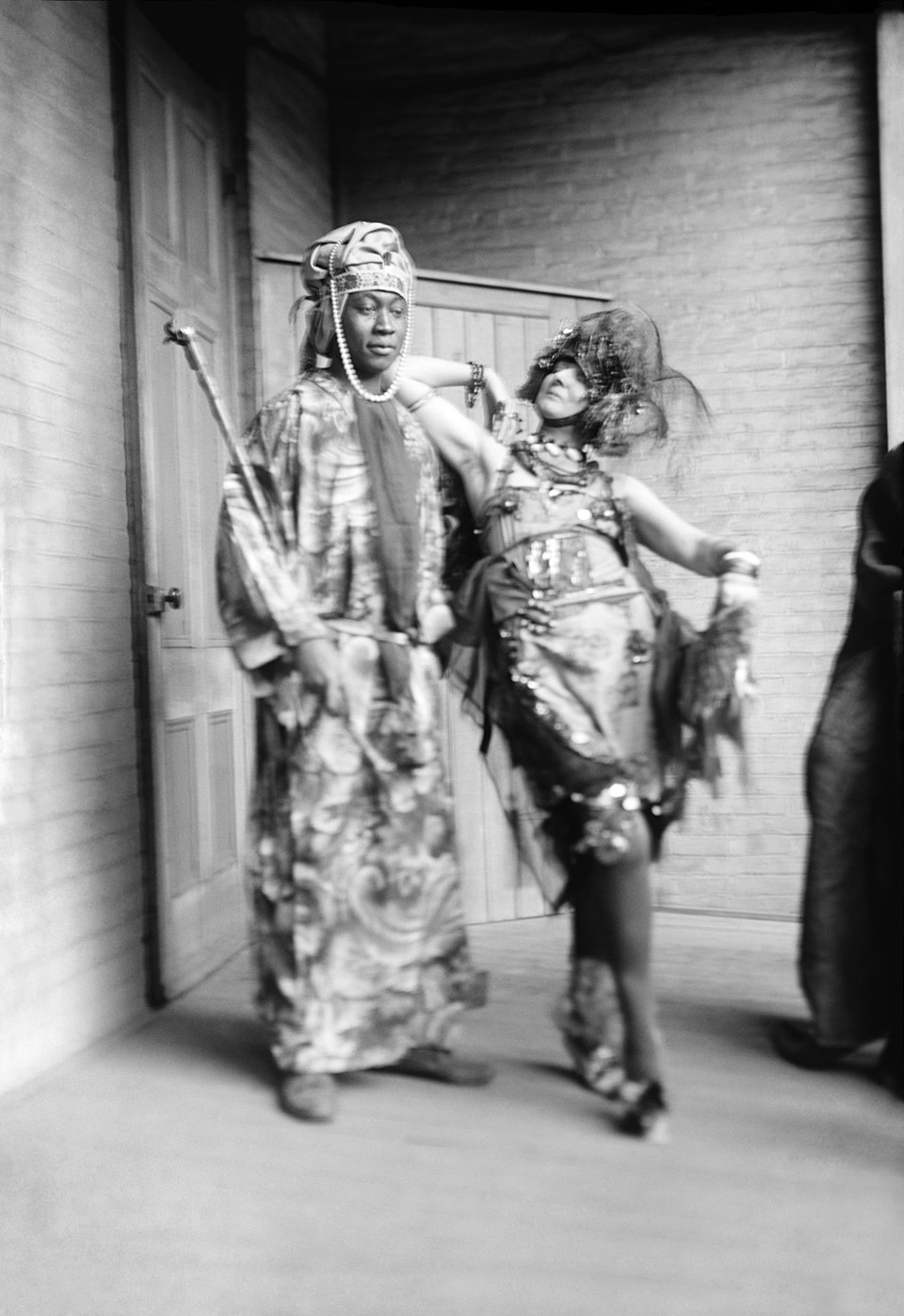
Claude McKay and Elsa von Freytag-Loringhoven, before 1928. Bain News Service. Library of Congress Prints and Photographs Division. No known restrictions on publication.
Notes on disputed or unproven points
* Elsa’s childhood. Modern biographies describe a deeply conflict-ridden family relationship and, in particular, serious problems with her father. Parts of this period can be reconstructed from testimony and biographical material, but it is not documented with the same degree of certainty as her later artistic activity. For that reason, the text above reduces it to “a difficult family life” and does not present more dramatic details as indisputable facts.
* The authorship of Fountain. The dominant institutional attribution remains Marcel Duchamp. The Philadelphia Museum of Art, Tate and other collections present the work under his name. However, there is an academic debate over whether Elsa von Freytag-Loringhoven may have taken part in its conception or submission.
* The letter of 11 April 1917. Marcel Duchamp’s letter to Suzanne Duchamp is documented. In it, Duchamp refers to a female friend who, using the male name Richard Mutt, had submitted a urinal as a sculpture. The letter does not identify Elsa.
* Elsa as the “female friend”. Identifying that friend as Elsa is a hypothesis developed by modern researchers. There is currently no document from 1917 explicitly stating that Elsa bought, signed or submitted Fountain.
* Elsa and Philadelphia. Some researchers who support the possibility of Elsa’s involvement in Fountain have used her links with Philadelphia during that period as part of their reconstruction of events and have attempted to connect the urinal with that city. These arguments have been challenged and should not be presented as established facts.
* “R. Mutt” and Armut. Some researchers have noted the resemblance between “R. Mutt” and the German word Armut (“poverty”) as a possible clue connected to Elsa. This is a later interpretation: there is no documentation from 1917 confirming that this was the origin or meaning of the signature.
* The origin of “R. Mutt”. The traditional explanation has connected the name with J. L. Mott Iron Works, while a possible reference to the comic strip Mutt and Jeff has also been suggested. The precise meaning of the signature has not been conclusively established.
* The origin of the urinal. The exact identification of the manufacturer and model of the urinal photographed by Alfred Stieglitz has been debated. Some arguments used to attribute the work to Elsa depend on that identification, but there is not enough consensus to use it as proof of authorship.
* The “R. Mutt” signature. It has not been established who physically wrote the inscription on the original urinal.
* Who had the idea. Nor has it been established who first conceived the proposal to present the urinal as an artwork. Traditional institutional sources attribute the selection and presentation to Duchamp; Duchamp’s letter introduces a contradiction that explains much of the current debate.
* Later research. Some researchers have argued for Elsa’s involvement and even her authorship; other specialists have rejected those conclusions because they consider the available evidence insufficient. There is no academic consensus allowing Fountain to be definitively attributed to Elsa.