Nicola Samorì
What Painting Hides Beneath the Skin
Nicola Samorì: What Painting Hides Beneath the Skin
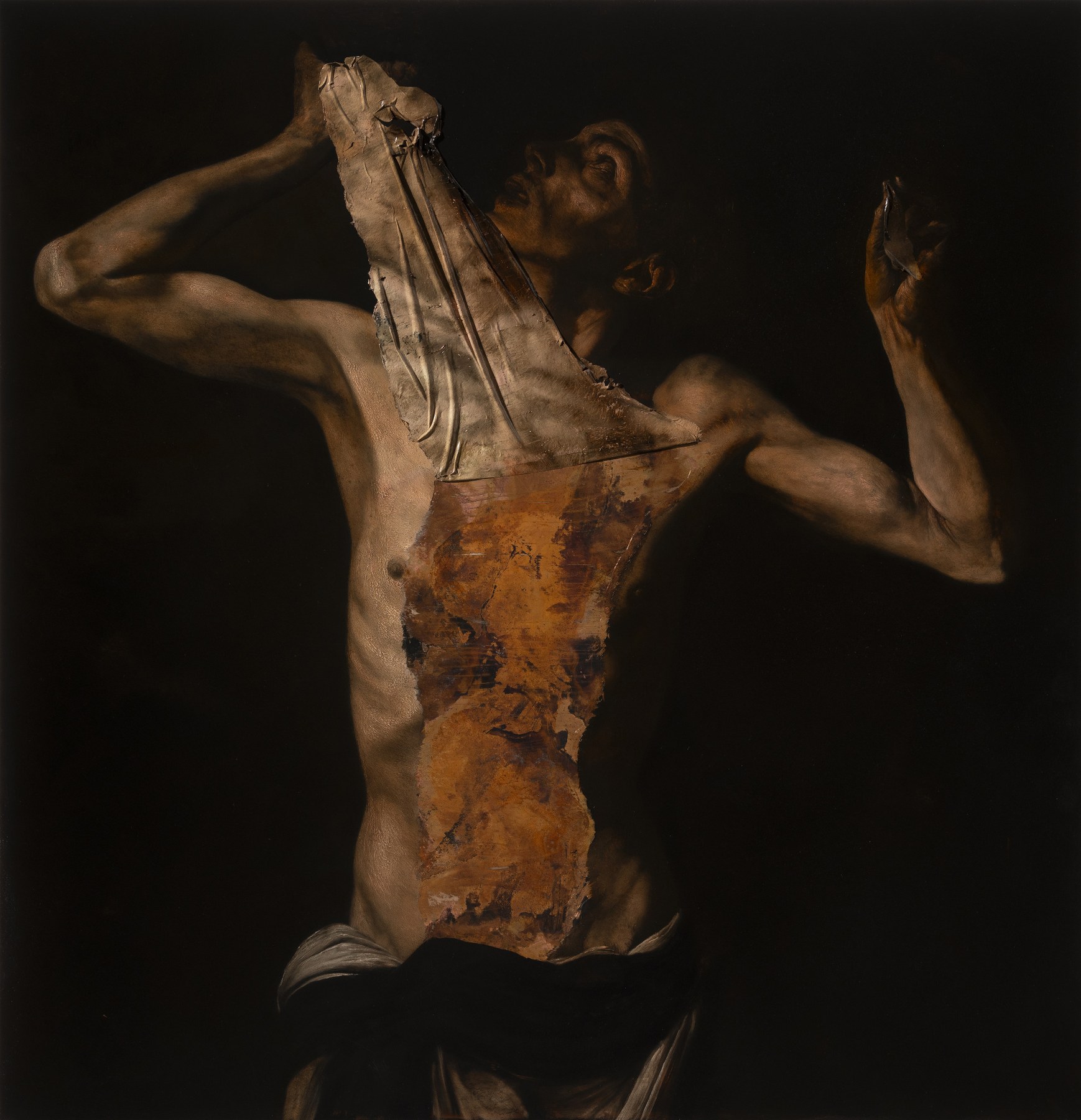
You have to know how to build an image before you can hurt it. In Nicola Samorì’s work, that idea changes almost everything. A wound may take only seconds to make, but before a surface can be opened there are hours of painting, knowledge, observation, and an extraordinarily intimate relationship with whatever will later be transformed. His figures emerge from a tradition we recognize even when we cannot immediately say where it comes from: bodies surfacing from darkness, saints, martyrs, faces in ecstasy, torsos illuminated as though something were about to be revealed. Then something else happens. The painting opens, lifts, loses part of itself, or allows us to see what would normally remain hidden underneath.
To reduce Samorì to an artist who destroys classical images is therefore to stop at the final gesture. His works begin much earlier.
Nicola Samorì was born in Forlì in 1977 and lives and works in Bagnacavallo. He studied at the Accademia di Belle Arti di Bologna, graduating in 2004, although his visual education had begun long before. Ravenna played an especially important role: its Byzantine mosaics, the marble of its basilicas, and the plaster casts preserved in the Academy’s Gipsoteca gradually formed a visual memory that still runs through his work. Over time, his practice expanded from painting into sculpture and into an increasingly physical investigation of stone, copper, pigment, surface, and body. His career grew to include increasingly significant institutional projects, among them Codice Italia, presented within the Italian Pavilion at the 56th Venice Biennale in 2015.
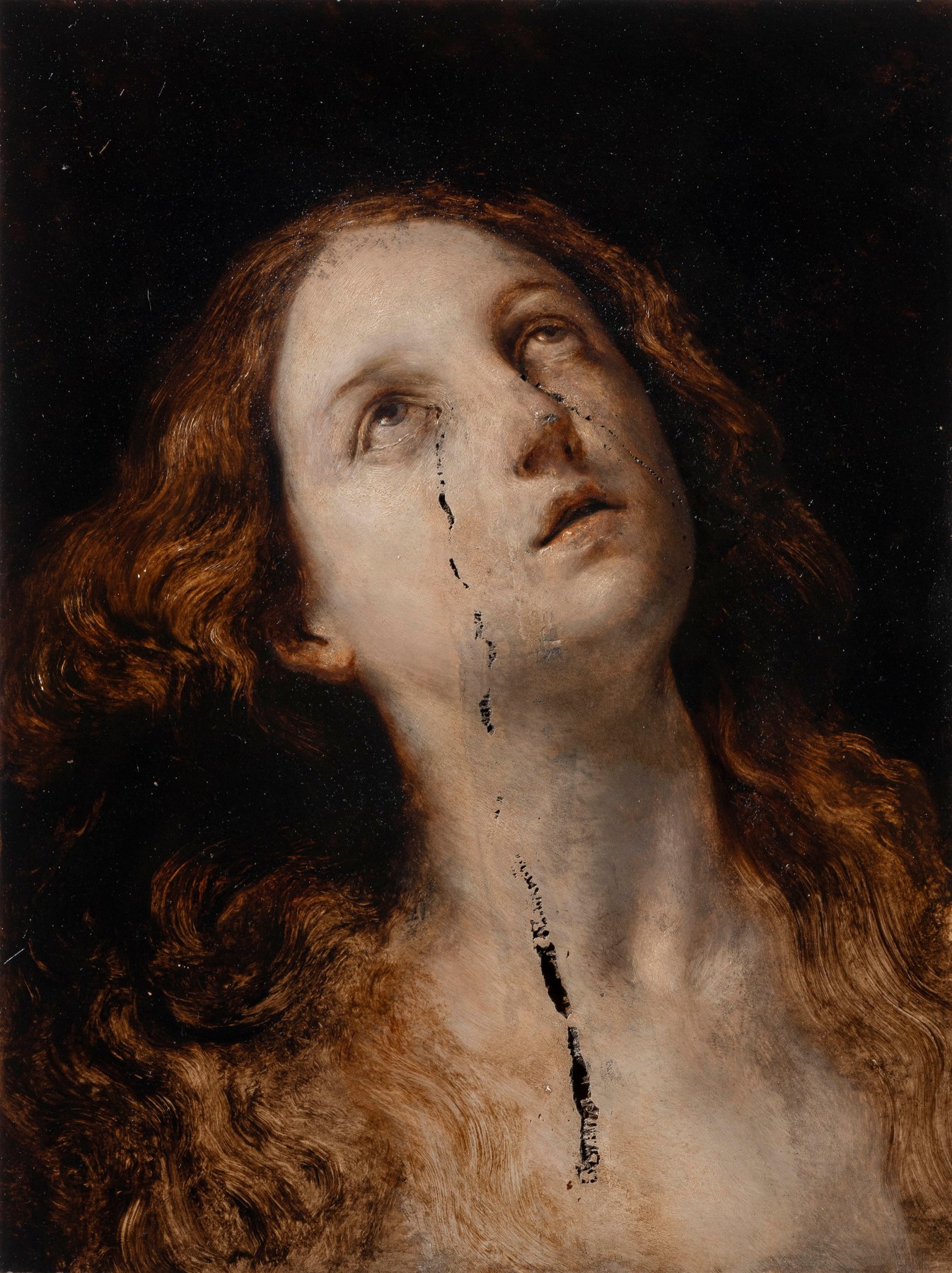
Nicola Samorì, Lacrimosa, 2020.
First, the image has to be built
In many of Samorì’s works, there is first an almost complete image. The chiaroscuro, the anatomy, the weight of a head, the translucency of skin, or the way a body emerges from a black ground all reveal how deeply he understands the visual languages he is using. They are not simply a backdrop for what happens afterwards. Without that initial construction, the second act would lose much of its force.
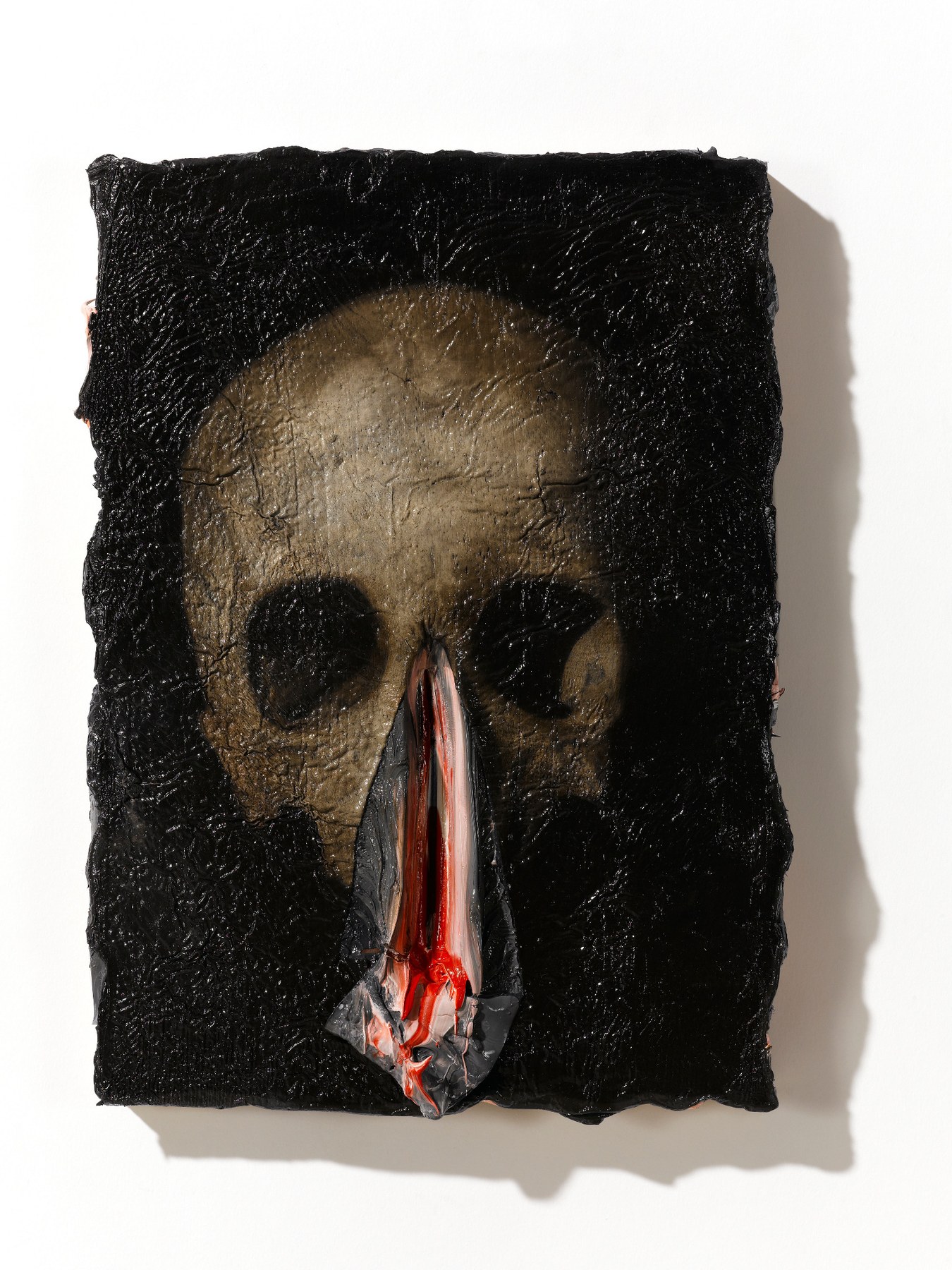
In one interview, he recalled an experience from childhood: seeing a rabbit being skinned. The scene became associated with a difficult transition between two actions performed upon the same body, first care and then violence. That tension between nurturing an image and placing it in danger appears again and again in his work. He has also spoken about the oscillation between healing and violence in his process, and about the need to build tension slowly before releasing a more radical gesture.
That forces us to look at his paintings differently. Samorì does not approach an image from the outside in order to destroy it. He brings it into existence himself, works on it until it acquires presence, and only then introduces the possibility of accident. The violent gesture may be immediate, but it depends entirely on everything that came before it.
To wound an image, it first has to matter to you.
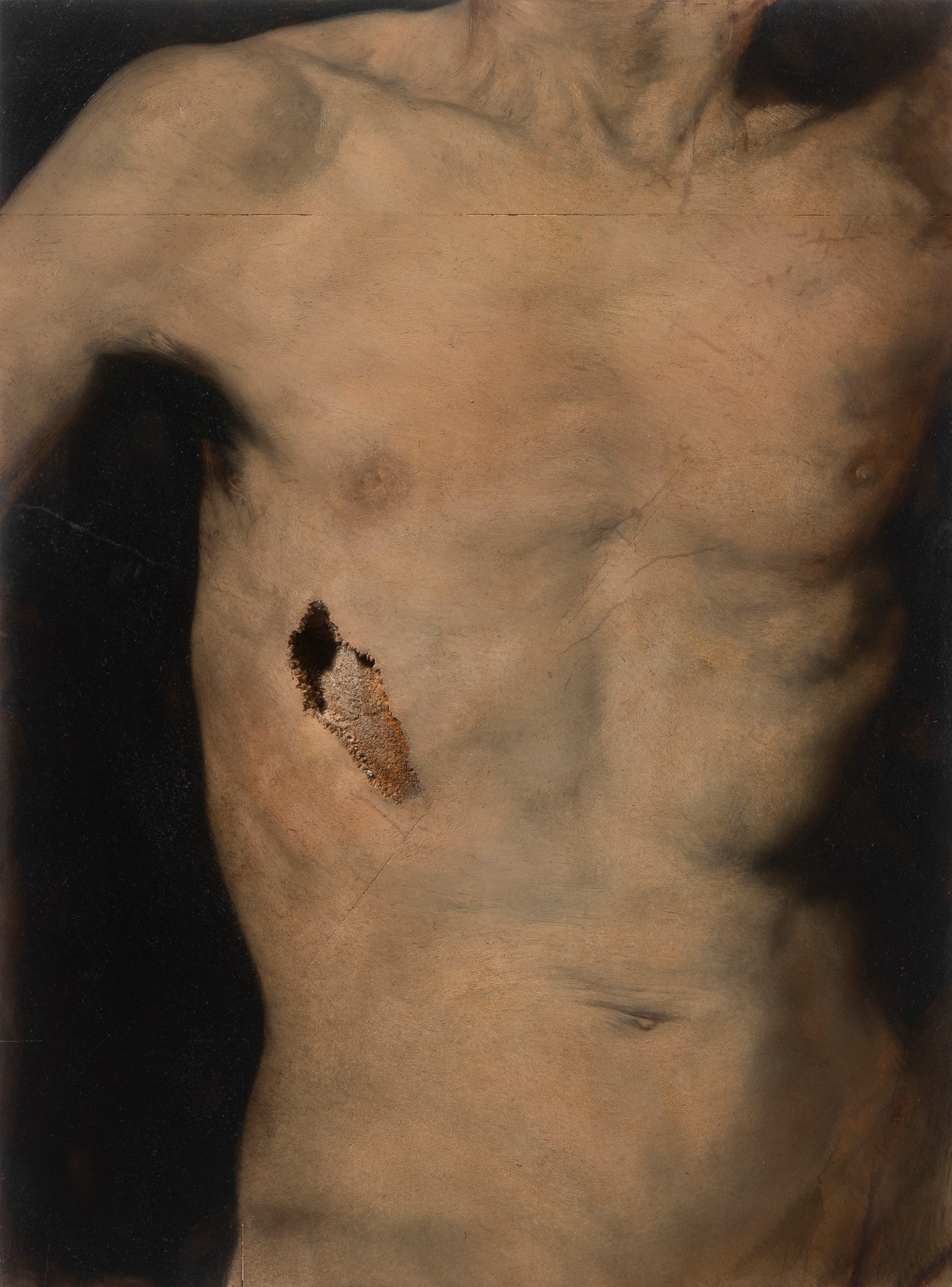
Nicola Samorì, Ultimo sangue, 40 × 30 cm.
Painting also has a body
We are used to looking at a painting from the front. For centuries, much of painting’s magic depended precisely on making us forget the object behind the scene: wood, linen, copper, pigments, oil, glue, successive layers, and a few centimetres of physical depth.
Samorì seems interested precisely in what we are not normally supposed to see. He has spoken about his fascination with looking at paintings from the side and from behind, searching for the reverse of forms and for whatever was never intended to be visible. When he scrapes a surface, lifts a layer of paint, or exposes copper and wood, the painting stops being merely a representation. The painting itself begins to behave like a body.
It has skin because it has a surface. It can be opened because it has depth. It can crack, lose parts of itself, or reveal the earliest gestures buried beneath its construction. In works made from stone, something even stranger happens: natural cavities, veins, and geodes enter directly into the anatomy of the figure. Where we expect to find an eye, a face, or intact flesh, we may suddenly encounter a mineral interior that had remained hidden for millions of years.
The selection made by Samorì himself for Art-onomi reveals this relationship with extraordinary clarity. There are torsos crossed by small losses that resemble actual injuries, heads whose faces begin to merge with the stone, and figures whose identity is interrupted precisely where the material decides to make itself visible. Painting and sculpture stop behaving as simple surfaces and begin, quite literally, to expose what they are made of.
A strange question begins to emerge: where does the figure end, and where does the object begin?
In some of his sculptures, that boundary disappears almost entirely. The stone retains the delicacy of a classical figure while a cavity cuts through the face. Samorì does not seem interested in forcing the material to pretend that it has no history. He does the opposite: he allows the vein, the void, the crystal, or the fracture to enter into the identity of the figure.
The material is not there merely to build the work. It can also alter it.
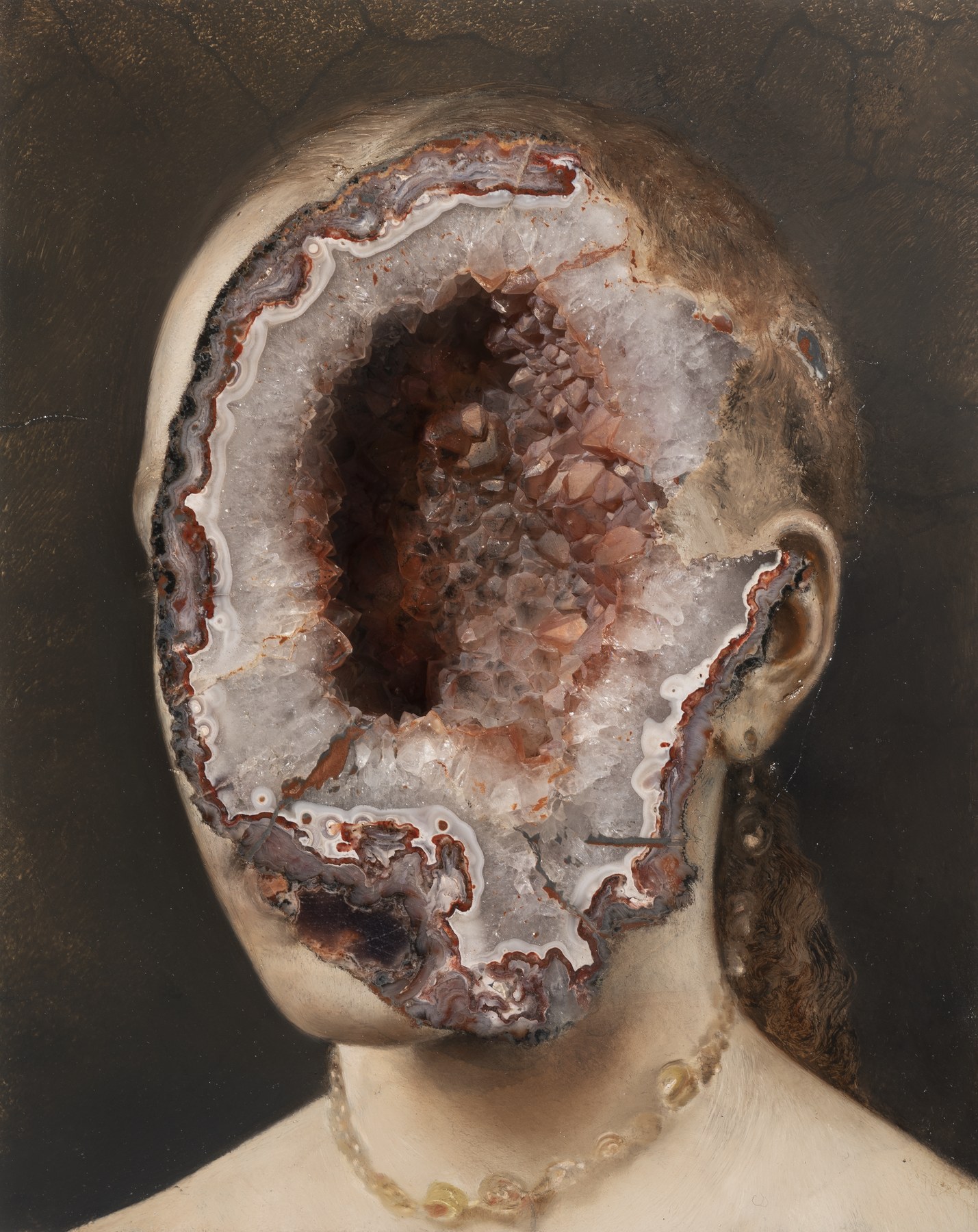
Nicola Samorì, DOM, 2023, 24.8 × 20 × 6 cm, oil on onyx and amethyst. Photo: © Rolando Paolo Guerzoni.
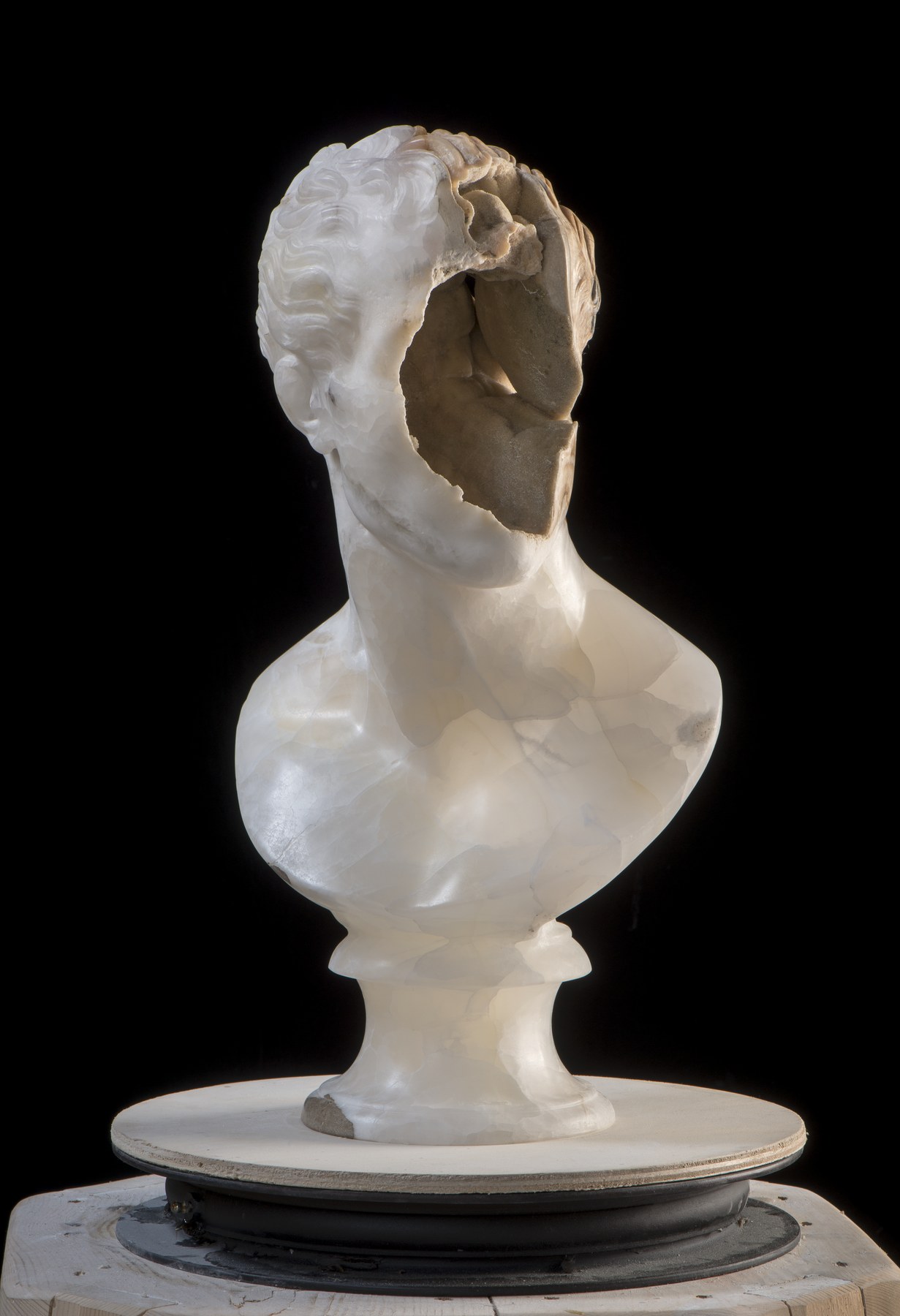
Nicola Samorì, Lingua Greca, 2017, 57 × 34 × 34 cm, onyx.
Violence is not the subject
Much of the writing around Samorì is filled with words such as wound, sacrifice, mutilation, flagellation, and destruction. It is understandable: when we see an opened face, language immediately searches for a way to describe aggression.
But the artist himself has kept a certain distance from that reading. During Sfregi in 2021, he acknowledged the wound as one of the codes running through his work, while also pointing out that many of the most violent terms come from those who observe and write about it. On a representation, he can perform a form of violence that would never make sense when directed at a living body.
That distinction matters because Samorì does not appear to have any interest in eliminating images. Quite the opposite. His work depends on continuing to believe in their power.
It might be far more radical simply to ignore the entire tradition that came before him. He does exactly the opposite. Again and again he returns to the Renaissance, Mannerism, Flemish painting, the Baroque, religious bodies, and a visual history he knows profoundly well. Then he allows something to happen inside those forms.
He does not destroy the past in order to free himself from it.
He forces it to continue.
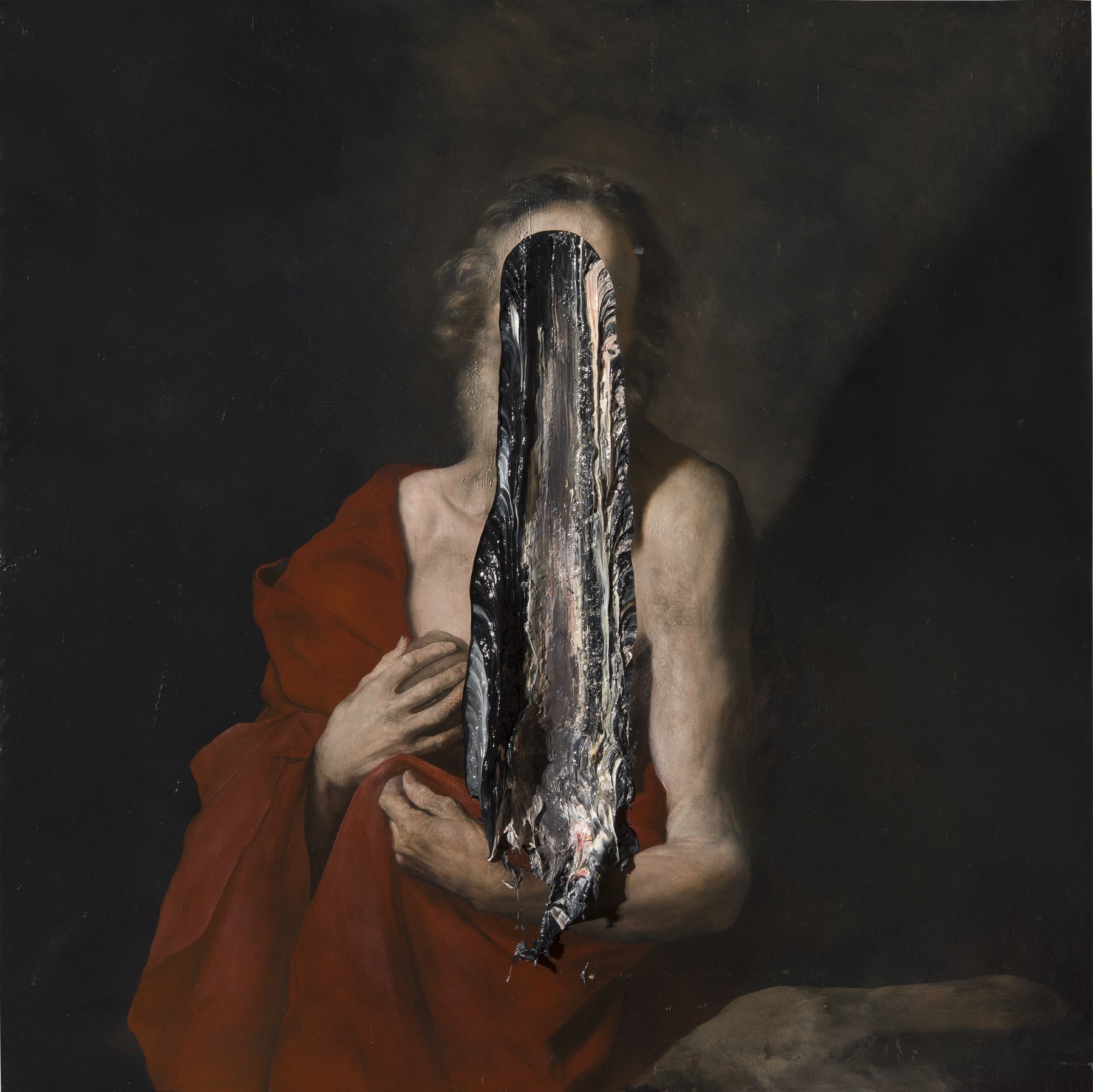
Nicola Samorì, Pietra penitente, 100 × 100 cm.
An image born with time inside it
Many of Samorì’s works create a difficult sensation to explain: they seem old even when we know they have only just been made. This is not simply because they recall historical painting. There is something in their surfaces that appears to have lived before reaching us.
The artist has spoken about the fragility of objects and about the contradiction within our desire to grant art a kind of eternity. Every body ages, changes, and eventually loses its form; a painting, however, is often preserved as though it were expected to remain stable forever. Samorì introduces that instability from the very beginning.
He does not wait for time to reach the work.
He lets it enter while the work is still being born.
That is why a crack, an absence, or an eroded surface does not feel like simple damage. It can behave almost like a memory of something that, in reality, never happened. A newly finished work receives an artificial past and begins its existence already carrying an age it has not yet lived.
There is something profoundly human in that decision. Traditional painting has often tried to defeat time. Samorì seems more interested in accepting that even an image can be mortal.
Nicola Samorì, work from 2012.
Darkness is not absence
Then there is darkness.
In Samorì’s work, it does not function merely as a tenebrist effect or as an easy way of dramatizing the body. He has spoken of darkness as the condition of things, and of light as a temporary episode. His figures seem to operate in exactly that way: they do not live entirely within light, but emerge from it for a moment.
A forehead, a chest, a hand, or a mineral surface appears while everything else remains contained by blackness. That blackness does not feel empty. It has weight. It pushes the body towards us while, at the same time, preserving something inaccessible.
We can see the skin with almost uncomfortable precision and still never completely possess the image.
In several of the works selected for Art-onomi, this contrast is especially strong. Bodies are partially absorbed by dark backgrounds while lighter surfaces remain exposed like vulnerable areas. In some pieces the material seems to detach itself; in others darkness invades the face or torso until it seems almost to acquire a physical presence of its own.
Darkness is no longer simply behind the image. It seems to be part of it.
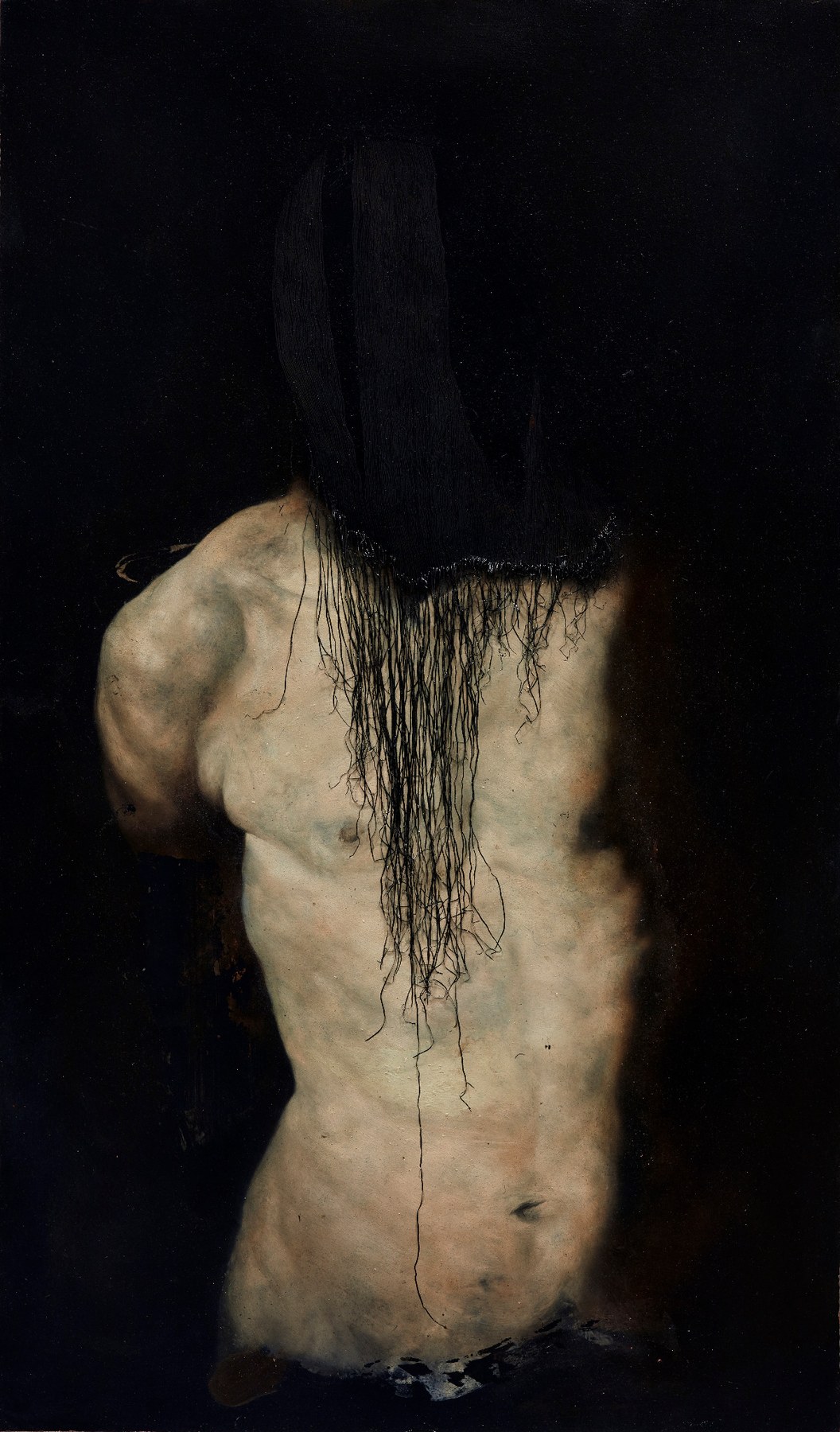
Nicola Samorì, Il corpo squisito, 2017, 85 × 50 cm.
The past is still breathing
Working with art history can easily become an exercise in nostalgia. Here, the opposite happens.
Samorì does not reconstruct the past in order to prove that it is still possible to paint as people did four centuries ago. Nor does he use historical images as a decorative repertoire. His relationship with them is more physical and, perhaps, more irreverent precisely because it begins with deep knowledge.
His work contains echoes of Caravaggio, Jusepe de Ribera, Flemish painting, and Mannerism, but also a clear awareness of modern artists who made material itself a central problem. Lucio Fontana physically opened the canvas; Alberto Burri burned, cracked, and transformed his surfaces. Samorì knows that territory, but he preserves something he considers fundamental: the figure.
A body still has to exist for the alteration to have something to act upon.
The past, therefore, is not protected. It can be touched, opened, mixed with other materials, and given new wounds.
That dialogue has found an especially clear expression in Classical Collapse, a recent project articulated across two venues: the Pinacoteca Ambrosiana in Milan and the Museo e Real Bosco di Capodimonte in Naples. Developed between 2025 and 2026, it brings together more than fifty works by Samorì in direct relation to the historical collections of both institutions. The project is not simply about placing contemporary art beside older art, but about making visible the fact that these different times can continue to contaminate one another.
The past stops being something finished.
It becomes another material.
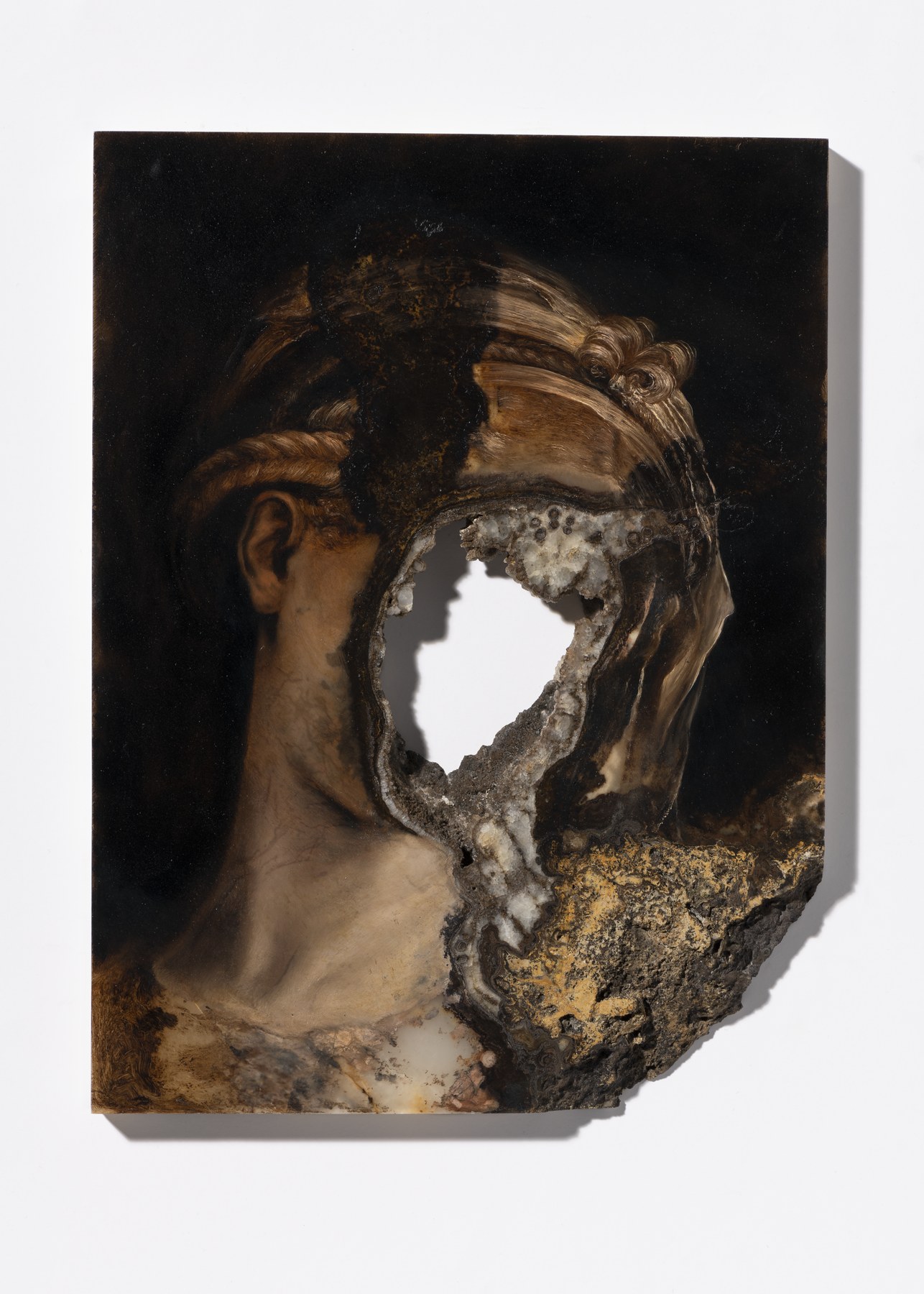
Nicola Samorì, Trittico delle Rocce B, 2022, 40 × 30 cm. Photo: © Rolando Paolo Guerzoni.
When a painting wants to leave the wall
Painting and sculpture have shared Samorì’s studio for years and have gradually moved so close to one another that they almost begin to merge. Painting separates from its support, lifts, gains thickness, and begins to behave like an object. Sculpture, meanwhile, absorbs cavities, veins, surfaces, and accidents that seem to belong to the language of painting.
The sculptural works selected for this article make this immediately clear. In some, a body carved from white stone retains the delicacy of classical anatomy while the material seems to open from within. In others, a bust keeps its human presence even as much of the face disappears into a mineral cavity.
Stone does not function as a neutral block that must disappear in order for the figure to exist. Its veins, cuts, and voids are part of the result.
It is a strange relationship: the artist builds, but does not always insist on having the final word.
At times, it feels as though he simply opens a door and allows the material to finish the sentence.
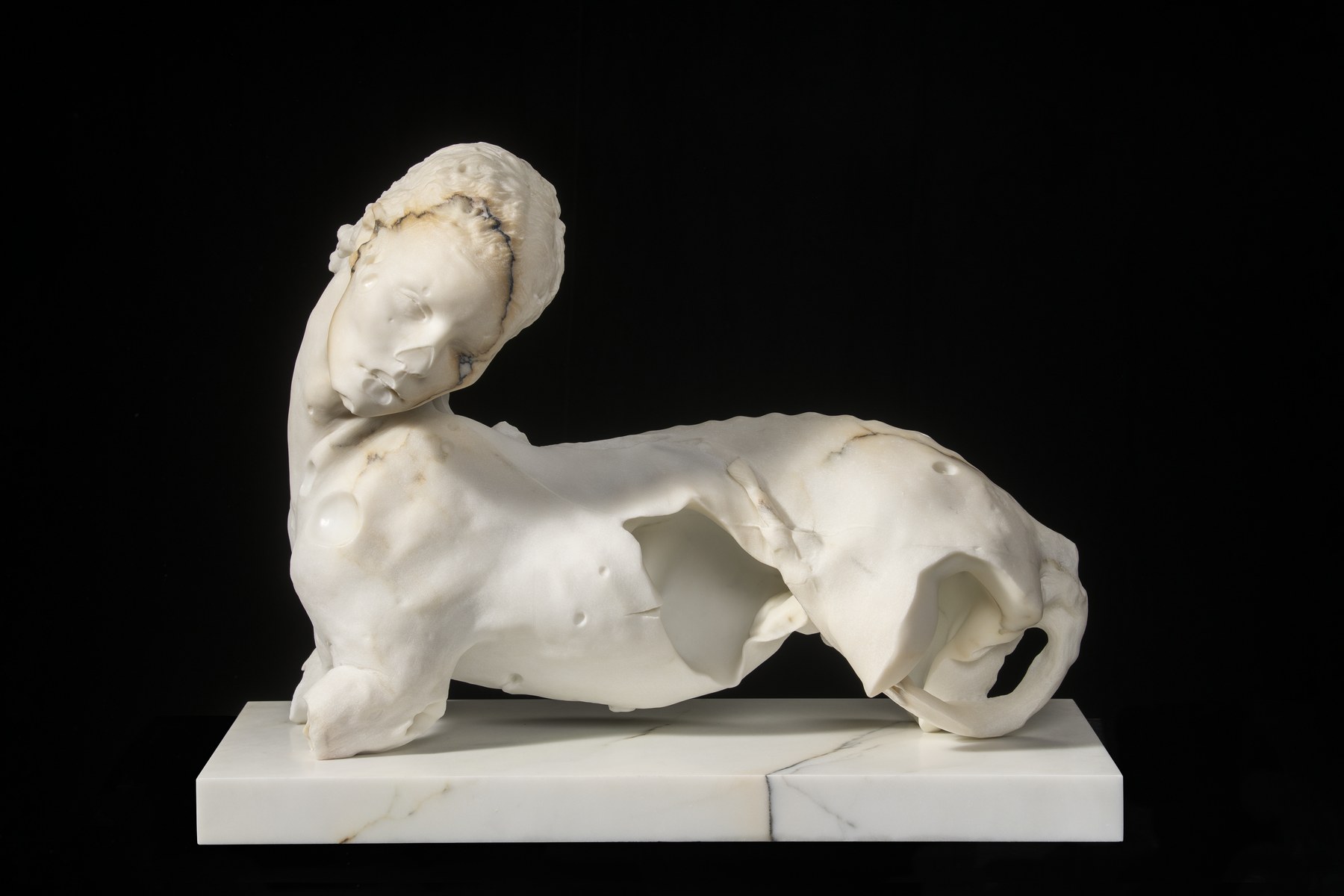
Nicola Samorì, Idolo riluttante, 2022, 71 × 34.5 × 53 cm, Paonazzo marble. Photo: © Rolando Paolo Guerzoni.
Growing without fully belonging
Samorì also seems uninterested in placing himself comfortably within a label. He can appear to be a figurative painter until the image begins to come apart; deeply classical until the support opens; a traditional sculptor until a geode replaces a face.
That constant displacement probably explains why his work is so recognizable and, at the same time, so difficult to reduce to a formula.
His career developed from exhibitions in galleries and independent spaces towards increasingly ambitious institutional projects. In 2011, he took part in the official Italian Pavilion at the 54th Venice Biennale, exhibiting at the Tese delle Vergini in the Arsenale. Four years later, in 2015, he returned to the same venue as part of Codice Italia, curated by Vincenzo Trione for the Italian Pavilion at the 56th Venice Biennale.
In 2012 came Fegefeuer / Purgatory at Kunsthalle Tübingen; in 2015, La pittura è cosa mortale brought together forty-five works made between 2008 and 2014 at Palazzo Chiericati in Vicenza; in 2020 he presented Lucìe at MART in Rovereto; in 2021 Sfregi occupied Palazzo Fava in Bologna; and in 2022 Le Ossa della Madre brought his work into Villa d’Este.
This is not a linear evolution from “painter to sculptor” or from “traditional to contemporary.” It is closer to a gradual expansion of the same problem: how much can an image change without ceasing to be itself?
Returning to the origin of the gaze
Within that trajectory, Supremalia, scheduled for the MAR – Museo d’Arte della città di Ravenna between October 2026 and January 2027, will carry particular significance because of the symbolic relationship between the project and the origins of Samorì’s visual language.
The exhibition will return the artist to an environment that was fundamental to his formation and will establish a dialogue with the Byzantine mosaics, the marble of Ravenna’s basilicas, and the plaster casts of the Gipsoteca that shaped his early years of looking. Supremalia will therefore be framed through the relationship between the artist, Ravenna, and a heritage that has continued to reappear in different forms throughout his work.
There will be something circular about that return.
After years of working with wounded surfaces, opened stone, and bodies that seem to come from another time, Samorì will return to the place where he first discovered how an image could survive for centuries.
But he will also return knowing that no image survives untouched.
A painting does not end when the painting is finished
Perhaps this is what remains most strongly after spending time with Nicola Samorì’s work.
His paintings do not seem interested in reaching a final state. They can open, lose skin, expose what lies beneath, harden, merge with stone, or become something we are no longer certain we should continue calling painting.
Traditionally, time comes after the work.
Here, it seems to be present from the beginning.
Perhaps that is why so many of his images have the strange ability to feel like memories even when we have never seen them before. They are born contemporary, but already contain a ruin. They are young and ancient at once. They are still becoming and, somehow, have already begun to disappear.
Samorì does not work against that disappearance.
He works knowing it exists.
When he opens the surface of an image, what appears underneath is not simply another layer of paint.
Sometimes, it feels as though time itself has appeared.
Where to find his work
Nicola Samorì’s work is held in public and private collections across Europe, Asia, and the United States. These include the Museo e Real Bosco di Capodimonte in Naples, as well as collections in China and Korea, alongside other institutional and private holdings internationally.
Rather than attempting to provide an exhaustive inventory, it is more useful to understand this presence as part of the increasingly international circulation of his work. As with many contemporary artists, inclusion in a collection does not necessarily mean that a particular work will be permanently on display.
Selected exhibitions and major projects
-
Italian Pavilion — 54th Venice Biennale — Tese delle Vergini, Arsenale, 2011 Samorì exhibited within the official Italian Pavilion at the Arsenale in Venice.
-
Kunsthalle Tübingen — Fegefeuer / Purgatory, 2012 One of the artist’s first major museum projects.
-
Italian Pavilion — 56th Venice Biennale — Codice Italia, 2015 Samorì returned to the Tese delle Vergini as part of the project curated by Vincenzo Trione.
-
Palazzo Chiericati — Vicenza — La pittura è cosa mortale, 2015 A major exhibition bringing together forty-five works made between 2008 and 2014.
-
MART — Rovereto — Lucìe, 2020 One of his most significant institutional solo exhibitions.
-
Palazzo Fava — Bologna — Sfregi, 2021 A particularly important project for understanding his investigation of wound, surface, and image.
-
Villa d’Este — Tivoli — Le Ossa della Madre, 2022 A project developed in dialogue with one of Italy’s most important historic complexes.
-
Pinacoteca Ambrosiana — Milan / Museo e Real Bosco di Capodimonte — Naples — Classical Collapse, 2025–2026 A two-venue project bringing together more than fifty works in dialogue with the historical collections of both institutions.
-
MAR – Museo d’Arte della città di Ravenna — Ravenna — Supremalia, 2026–2027 An exhibition scheduled from October 2026 to January 2027, conceived in relation to the mosaics, marble, and plaster casts that shaped the artist’s visual formation.